Beyond the Model, Episode 1: Five Lessons on Winning in the Age of AI
5 MIN. READ
The banks that win with AI won't be the ones running the most experiments. They'll be the ones willing to redesign how work gets done, and to accept "better" instead of waiting for "perfect".
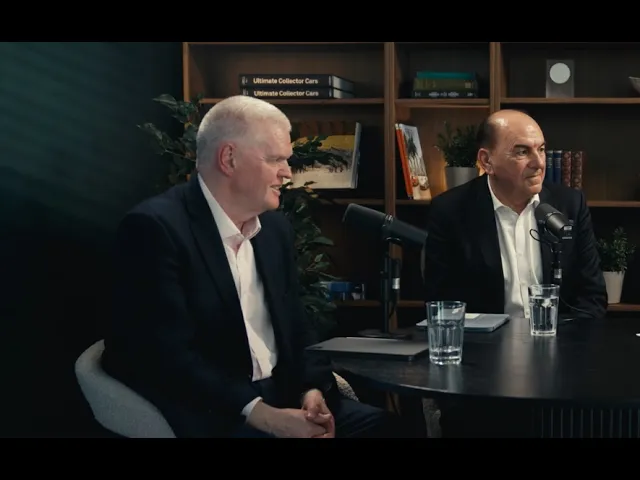
That was the through-line of the first episode of Beyond the Model, Model ML's new podcast bringing the most senior voices in global finance together to discuss how to win in the age of AI.
We were honoured to welcome two of the most experienced leaders in global banking as our first guests: Sir Noel Quinn, former Group CEO of HSBC, and Alex Weber, is the former Chairman of the Board of UBS. Between them: more than 200,000 employees managed, trillions in assets overseen, and two of the most consequential bank transformations of the last decade.
Here are five lessons from the conversation.
1. "Perfection" is the enemy
Every bank hears the objection that imperfect AI is useless. This assumes humans are perfect, when people in large, legacy-bound institutions make decisions on incomplete, disconnected data every day. AI doesn't need to be flawless, it just needs to be better than the status quo.
2. AI will result in a completely new operating model
At HSBC, pricing complex multicurrency FX derivatives went from hours, sometimes a full day, to two or three minutes, with a complete audit trail. All with the same trader and same decision rights, but with a completely different operating model.
3. Focus over experimentation
Alex Weber warned against treating AI adoption as an exercise in activity. Running dozens of disconnected pilots across an organisation may create the appearance of progress, but it seldom delivers lasting value. In his view, the institutions that succeed will concentrate on a small number of core applications, commit substantial investment to them and see them through with sponsorship at the highest level.
4. Build versus buy: the leader as systems designer
Sir Noel Quinn argued that business leaders should approach technology as systems designers and integrators rather than developers. The starting point is the ideal customer experience. From there, leaders should map the underlying workflow and identify the best available components to support it, reserving in-house development for areas that represent genuine intellectual property or a clear competitive advantage.
5. AI literacy as a leadership requirement
Weber was equally clear that financial expertise, while still essential, is no longer sufficient on its own. The leaders who thrive in the years ahead will be those able to work effectively in teams that combine people and technology, and who approach their businesses with an AI-native mindset.
The bigger picture
Taken together, the message from two leaders who have steered some of the world's largest banks is clear. Winning with AI is less about the technology itself and more about leadership: setting the right benchmark, committing to a few things that matter, redesigning how work gets done, and building teams fluent in both finance and AI.
Watch the full episode here.